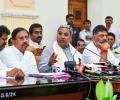
'Karnataka's finances are much healthier than the Union government's, which is indebted to nearly twice the extent of the state.'

The government is committed to restrict the fiscal deficit at 3.4 per cent of GDP as envisaged in the Budget.

'It is important for states to agree 10-15 per cent duty cut and take home the same amount of tax revenue as budgeted.'

To offer additional support at the low end of the income ranges, the Centre will consider a large-scale jump in exemption rates under the old income-tax regime in the vote on account, or interim Budget, according to a senior official in the know. Those will include an extension of the income tax exemption rates close to Rs 7 lakh and additional measures for women farmers.

While the central bank had publicly cited only Rs 15.55 trillion of high value notes were cancelled, in an RTI reply to PTI, it had said the actual quantum of bills cancelled was much higher at Rs 20.51 trillion.

'The rupee falling from 69 to 72 was not normal or justified by the fundamentals.' 'And therefore I treat this as temporary.'
It was 55.3 per cent for the same period last year, and data shows the fiscal deficit for April-May was kept in reasonable check in spite of heavy frontloading of expenditure.

Hindustan Zinc (HZL), a subsidiary of Vedanta, announced an interim dividend of Rs 21 per share last week, resulting in an outflow of Rs 8,863 crore. The announcement has turned the spotlight on India Inc's dividend-paying policy - more so for reasons driving the generosity of firms. An analysis of BSE 500 companies by Business Standard Research Bureau shows that some of the top 20 dividend-paying companies in 2021-22 (FY22) include Vedanta, Tata Consultancy Services, HZL, Oil and Natural Gas Corporation (ONGC), Indian Oil Corporation (IndianOil), Hindustan Unilever (HUL), Reliance Industries (RIL), and Bajaj Auto, among others.
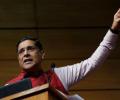
Chief Economic Advisor Arvind Subramanian spoke on a wide range of issues -- from GDP growth and fiscal consolidation to job creation and GST.

Days after cutting the salaries and other allowances of MPs and ministers, the government has passed instructions to all departments to reduce their expenditure by as much as 60 per cent from their first-quarter spending plans.

'Kindling the private sector's animal spirits is more important than focusing on how government can give jobs on its own.'
After the April-July fiscal deficit data was released on August 31, several analysts hinted that the government may need to go for cuts in capital expenditure to meet the fiscal deficit target.
Even with the possible expenditure roll-overs and off-budget financing, the fiscal deficit target will not be met. The FRBM Act, after its amendment in 2018, allows a fiscal deficit slippage of not more than 0.5 per cent for any given year, provided there are justifications. These justifications include war, national security, severe collapse in the agriculture sector, a major natural calamity, big structural economic reforms, or the decline in real output growth of a quarter by at least 3 percentage points below its average of the previous four quarters.

Though this is part of the divestment drive, government's stake in these companies remains 100 per cent even after the buybacks

'The finance minister in her Budget speech should spell out how exactly she intends to get back to the 7% track, and the hard decisions she intends to take in order to adjust to the realities of a slowing economy until growth momentum returns,' suggests T N Ninan.
This move will enable it to incur higher-than-mandated borrowing, and possibly spending, till the 2024 Lok Sabha election cycle.

There are several welcome standalone reforms, but these do not add up to a coherent strategy to achieve a $5 trillion economy or secure Aatmanirbharta, observes Rathin Roy.

The gap between expenditure and receipts totalled Rs 3.98 crore (Rs 39 million) over the April 1-August 31 period against the Rs 5.31 lakh crore(Rs 5.31 trillion) pegged in the Budget for 2014-15.

The promise of a less suspicious government is surprising. What about the disconnect between the new business stance and earlier push to dictate the narrative in politics and public life, wonders T N Ninan.
A faltering economy may have led to a re-think on economic strategy. And Mr Modi might think he is politically strong enough to take some risks. But there could be a minefield ahead, observes T N Ninan.
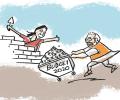
'The next general election is four years away. That's enough time to recover -- provided the government stops spending and taxing so much,' says T C A Srinivasa-Raghavan.

India's fiscal deficit touched Rs 4.57 lakh crore or 84.4 per cent of budget estimates in the first seven months of the current fiscal, reflecting signs of stress in government finances.

The government had breached its fiscal deficit target given in the Budget for 2017-18 in November itself, touching 112 per cent of the limit.

The agency attributed the sharp revision to various high-frequency indicators showing a softness and partly blamed the same to reforms like GST, real estate regulation, and the bankruptcy code which are still a "drag" on the economy.
Various indicators make it amply clear that there are grave challenges facing the new government of Chief Minister Nitish Kumar, reports Indivjal Dhasmana.

The biggest disappointment was the compromise on the promised corporate tax reduction path.

IDS-2 and raids to uncover black money stash keep receipts flowing

With the disruption caused by the second wave of Covid-19 pandemic, the 'fear of unknown' is looming over the government's privatisation drive. Although there is a lot of uncertainty and unpredictability on how things will unfold, the government is hopeful of completing the transactions listed in the Budget with a delay of one to two months, said a top government official. However, "there are many unknown factors now, and we do not know whether there could be a third wave. But we are trying to carry on with our work", the official said." Since there is a lot of uncertainty, the estimates will have to be revised as rating agencies are revising their outlook for growth.

On the revenue front, the finance ministry was expecting higher proceeds from non-tax revenue.

However, economic growth in five years of the UPA and NDA cannot be compared because of the now complex back series data, reports Indivjal Dhasmana.

Here's what could be ahead for India: A $10-trillion economy by 2030-32, a Sensex at 1,00,000 by 2025, monthly GST revenues at Rs 2 trillion by 2024-25, 100 new unicorns by 2025, and poverty below 5 per cent by 2030, predicts R Jagannathan.

The review stresses on creating conditions for growth that is employment-friendly.

The budget-making exercise offers golden opportunities despite challenges, observes Shankar Acharya, former chief economic adviser to the Government of India.

IThe fiscal deficit target for 2020-2021 was originally set at 3.5 per cent of GDP. But the government's revenues have collapsed and its expenditure burden will only increase over the Budget estimates.' With the government having already planned for an additional borrowing of over Rs 4 trillion, the fiscal deficit for the current year would be much higher than the Budget estimate, notes A K Bhattacharya.

'Tinkering will not do. Merely staggering spectrum dues comes nowhere near solving the problem,' cautions Rahul Khullar.

For the PMO this is urgent as the Digital India framework would depend on how the telecom companies perform. It is also linked to the proposed auction of 5G airwaves.

The Centre on Thursday hoped that "some political solution" would emerge paving the way for formation of a popular government in Delhi as political parties questioned the delay in this regard and said it was hurting infrastructure in the national capital.

The challenge of achieving fiscal deficit targets for the next two years seems daunting.

Senior policymakers say it is a tough task and the finance ministry may resort to the time-tested method of carrying forward part of the subsidy payment burden to the next fiscal year.

The comments from Das assume importance as the government for two consecutive terms have missed its fiscal deficit targets by 10 bps
